2026.05.05

500 Global Team
Lessons from the World Bank Spring Meetings on what it takes to move from pipeline to deployment.
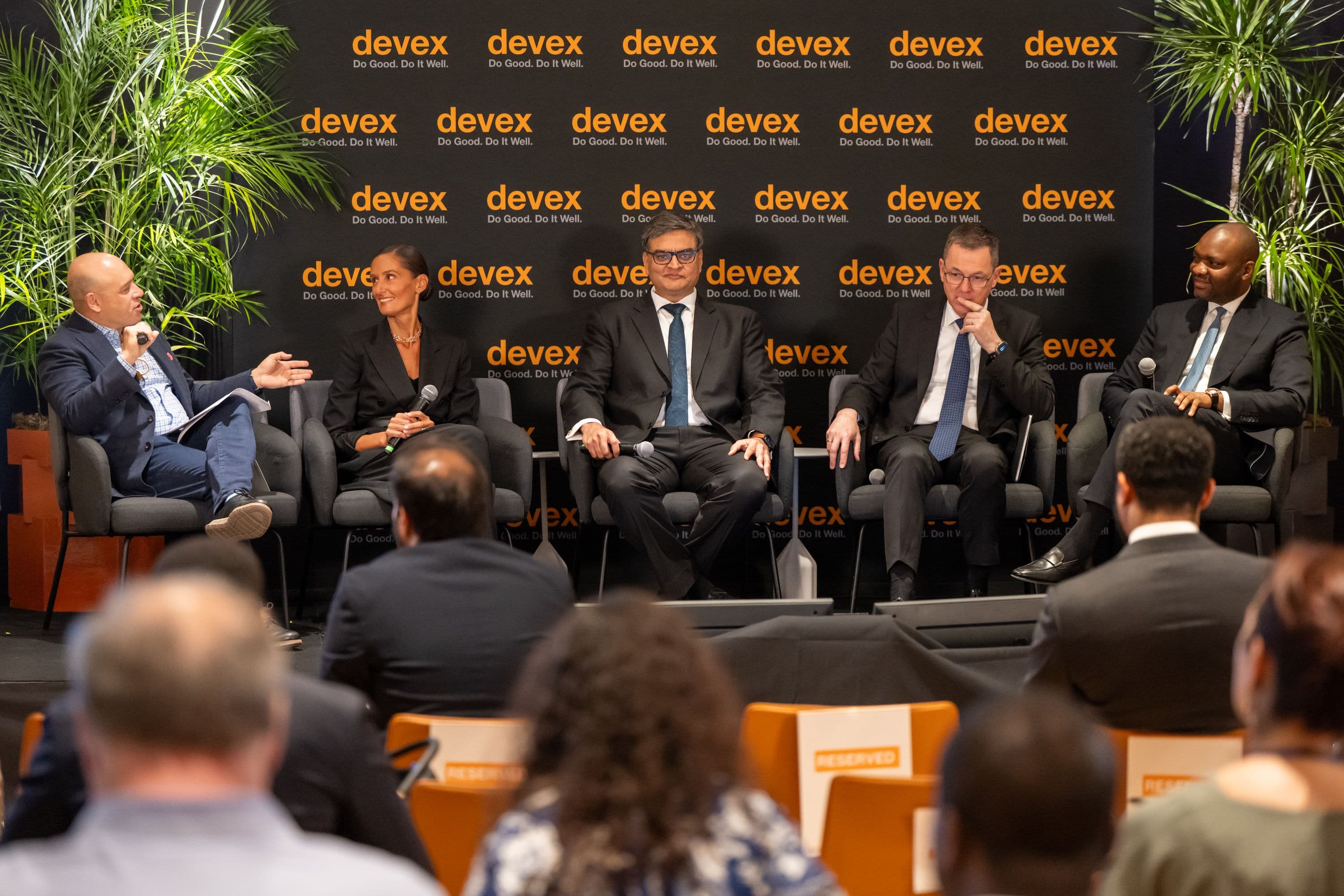
At the Devex Impact House during the World Bank Spring Meetings, Africa50, the International Solar Alliance, the Nigeria Sovereign Investment Authority, and 500 Global came together to examine what it will take to scale sustainable energy across Africa. The conversation produced a clear and shared conclusion: the opportunity is real, but the pace of technological progress must match system readiness. Without that alignment, the gap between innovation and deployment will likely continue to constrain how effectively climate ventures — and the institutions backing them — can operate at scale.
The scale of what is at stake is increasingly hard to ignore. Over 600 million people across the continent still lack access to electricity — nearly 80% of the global electricity access gap — and closing it requires almost $15 billion in annual investment. Africa holds over 60% of the world's best solar potential, yet captures only a fraction of global clean energy investment. African energy is undergoing a fundamental shift: what was once viewed solely as a development necessity, we now see it emerging as a compelling commercial opportunity and a scalable, institutional-grade asset class. For sovereign and development finance institutions, we believe this represents not just a development imperative but an increasingly well-defined asset class — one where the architecture of how capital is structured matters as much as how much is deployed.
At the same time, the venture data tells an equally compelling story. In 2025, clean tech attracted $1.18 billion in funding across Africa — 99% year-on-year growth, making it one of the fastest-growing sectors in the ecosystem. Founders are building scalable models in clean energy, climate-smart agriculture, mobility, and carbon solutions. We saw this first hand when launching the Sustainable Innovation Seed Accelerator in Nairobi (SISA program) last fall, which drew 600+ applications across 20+ countries — 70% of which were climatetech — bringing problems that required not just capital but system readiness support.
And yet the central challenge we keep returning to is not whether the technology works or whether the capital exists. It is whether the systems that enable scaling — aligned capital, regulation, capital markets, grid infrastructure, verification standards — are evolving fast enough to meet them. We call this systems-market fit: the degree to which a company's technology, capital strategy, and operating environment evolve in coordination. When that alignment is present, we believe that scaling pathways tend to be clearer. When it is not, growth would likely get constrained by structural frictions that may have nothing to do with product performance.
Strengthening System Readiness
Unlike typical tech startups, climate ventures often operate at the intersection of technology, policy, infrastructure and finance. Their success depends not only on demand for a product or service but typically also on coordination between institutions, markets, regulators and capital providers.
For example, access to climate finance or emerging carbon markets requires approval from regulatory bodies, robust data reporting, and institutional readiness that may lag behind the pace of innovation. This reality underscores why systems-market fit — where innovation and system stability move in tandem — is essential for long-term impact.
Take one of the companies in our SISA program, Koolboks, a Nigerian clean tech company supplying solar-powered refrigeration to farmers and small businesses. To unlock its next phase of growth, the company will need to generate revenue beyond product sales. Carbon credits are an obvious lever. But accessing international carbon markets increasingly requires host-country authorization, and Nigeria is still building the foundations: a national carbon registry, clear authorization pathways, and codified rules on community benefit-sharing. Kenya, by contrast, has already put a number of substantial measures towards implementing carbon projects and supporting Kenya's Nationally Determined Contribution (NDC) under the Paris Agreement and has been among Africa's largest issuers of carbon credits and one of the recognized leaders in the continent's carbon market. We believe this difference has practical implications — it could determine whether a company like Koolboks can monetize its climate impact at scale.
This is precisely the kind of system-building that requires coordination across the full institutional stack — and where 500 Global, Africa50, and NSIA each have the potential to play a distinct but complementary role. Sovereign and development finance institutions bring the policy influence and capital architecture to shape the regulatory environment at a national level. Ecosystem enablers like 500 Global work from the ground up — equipping founders with the tools that help them to assess their own system readiness, identify the gaps, and engage constructively with the stakeholders who shape it: regulators, governments, and advocacy bodies. The contrast between Nigeria and Kenya on carbon market infrastructure is not a story of one market falling short: we view it as a reminder that system-building is iterative, and that Nigeria's current moment of architecture-building is an opportunity for exactly this kind of coordinated engagement. That is the work our SISA program was designed to support, and we believe that it is most effective when venture, sovereign, and development capital are pulling in the same direction.
Climate Tech’s Evolving Landscape
We believe Africa's climate tech ecosystem is entering a more structured phase as capital volumes increase, financing instruments diversify, and institutional engagement with sustainability-linked sectors becomes more established.
At the Devex Impact House, a clear theme emerged: the next phase of climate tech financing in emerging markets may depend on more sophisticated blended finance structures — capital designed not just to absorb risk, but to enhance returns for the capital sitting alongside it. Sovereign institutions like NSIA and Africa50 discussed how they are increasingly playing this role, structuring partnerships that channel public and concessional capital in ways that improve the risk-adjusted returns available to private investors and crowd in capital at meaningful multiples.
As 500 Global Managing Partner Nadia Karkar noted during the panel, African climate tech is too often narrated through the lens of risk. The more productive framing — and the one that brings new classes of capital into the sector — is opportunity: what well-structured concessional capital has the potential to unlock, and the potential return uplift it offers to investors deploying alongside it. Sovereign and development institutions in this space are not just de-riskers. They are return-enablers.
Beyond financing, there was meaningful discussion of the talent pipeline. As capital flows in, the demand for engineers and project developers needs to match current supply. Sustained investment in human capital is what allows financing to translate into deployment. Regulatory frameworks matter for the same reason: as consumers across emerging markets diversify their energy mix, clearer rules on grid integration, off-grid licensing, and carbon market authorization will determine how efficiently new capital is put to work.
We believe that the continued evolution of capital markets, policy frameworks, and ecosystem coordination will determine how effectively climate innovation translates into sustained outcomes. What became clear at the Devex Impact House is that the institutions in that room — sovereign, development, and venture — are not waiting for that evolution. They are building it. The question now is pace and coordination, and that is a conversation worth continuing.
Watch the full conversation