2026.05.21

Amjad Ahmad - Managing Partner, 500 Global VC Unlocked: AI Instructor
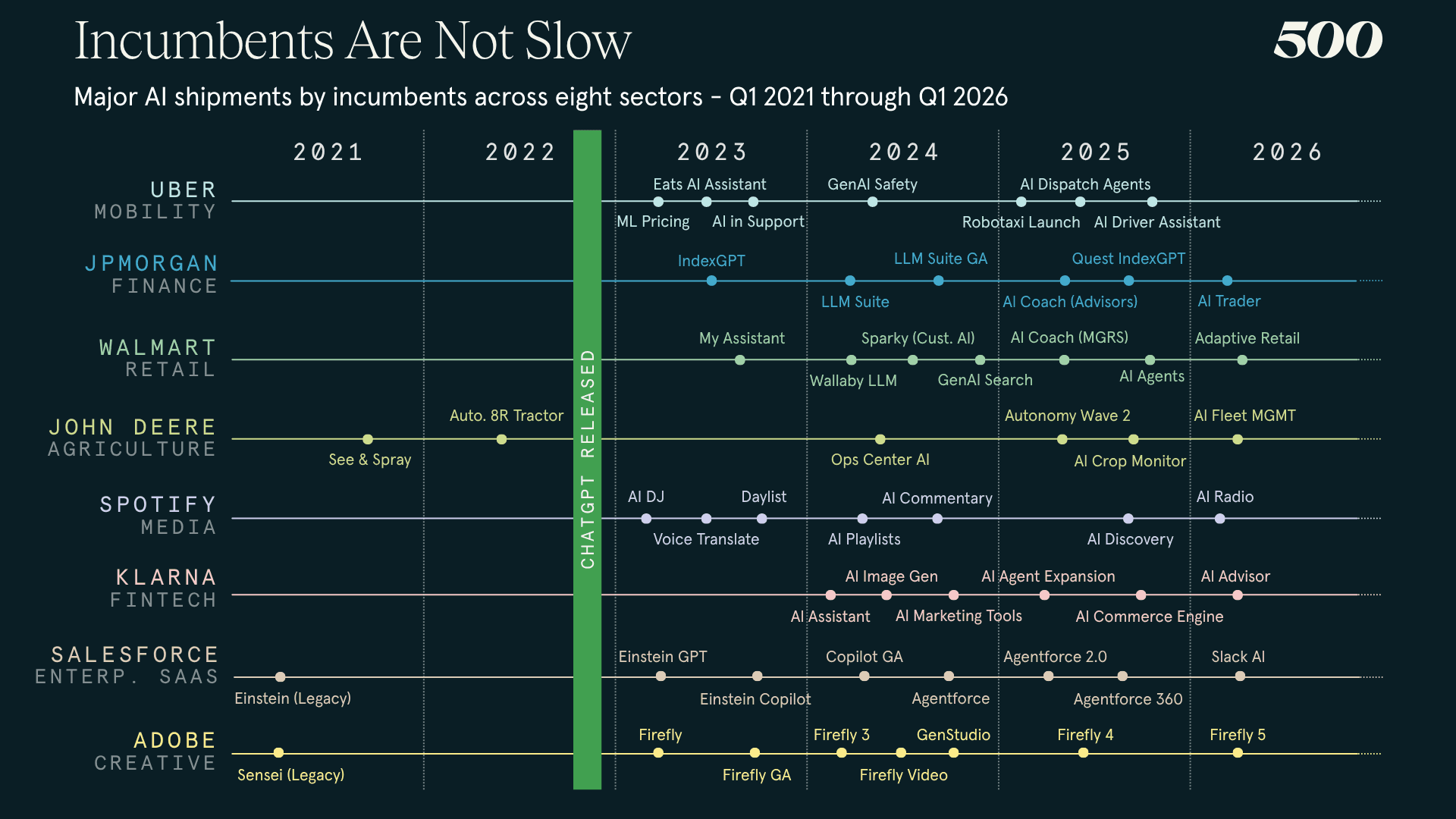
For most of the past two decades, the venture playbook assumed that startups would beat incumbents by moving faster. The historical pattern supported it: incumbents were late to the internet, late to mobile, late to cloud — and paid for it.
Each successive wave of disruption rewarded speed of adoption.
That pattern does not hold in AI.
Today's incumbents are not yesterday's incumbents
The managerial cohort that missed the internet has aged out. The leaders running Microsoft, Salesforce, ServiceNow, and Adobe today are a different generation — founder-influenced or product-led, deeply technical, and already adapted to multiple platform shifts. Some are founders themselves running AI-forward engineering organizations. Others are operators who grew up in the digital age and brought that playbook with them into established companies.
And this is not just a software story. Walmart, JPMorgan, and John Deere are shipping AI products inside retail, finance, and agriculture — at a cadence faster than they adopted internet, mobile, or cloud.
Corporate AI adoption is accelerating, not stalling. The internal AI deployment cadence at large software companies is now faster than at most early-stage startups. They are experimenting, identifying what works, and shipping products to their millions of customers.
Build vs Absorb
Startups build. Incumbents absorb.
In AI, where features are easier to replicate than ever, this dynamic between startups and incumbents accelerates. The cost and time required to bring a competitive feature to market have collapsed.
The question is no longer "Can they build this faster?"
It is "What happens when the incumbent ships this?"
This is where the AI Moat framework matters most. Open-loop products without workflow ownership do not compete with incumbents — they get absorbed by them.
The Real Risk
Three "advantages" I see cited repeatedly in AI investment memos that rarely hold up against an incumbent response:
- better UX
- faster iteration
- a first-mover claim
Each of these can be matched — and often surpassed — by an incumbent within a quarter of seeing the startup ship.
A startup whose entire thesis rests on the advantages listed above is not building a moat.
It is building a roadmap for an incumbent.
The Incumbent Test
Three questions I am now asking before any AI investment:
- Does the startup own a complex workflow that is challenging to enter?
- Does it have data that compounds in ways others cannot?
- Does it have sector depth that cannot easily be replicated?
If all three answers are no — and the only advantage is speed — the moat is fragile.
In AI, a proprietary data flywheel and workflow ownership compound faster than product velocity. Incumbents have the distribution.
Startups can still win — just not on speed alone.
Read more AI Frameworks to continue learning how investors are rebuilding the VC playbook. 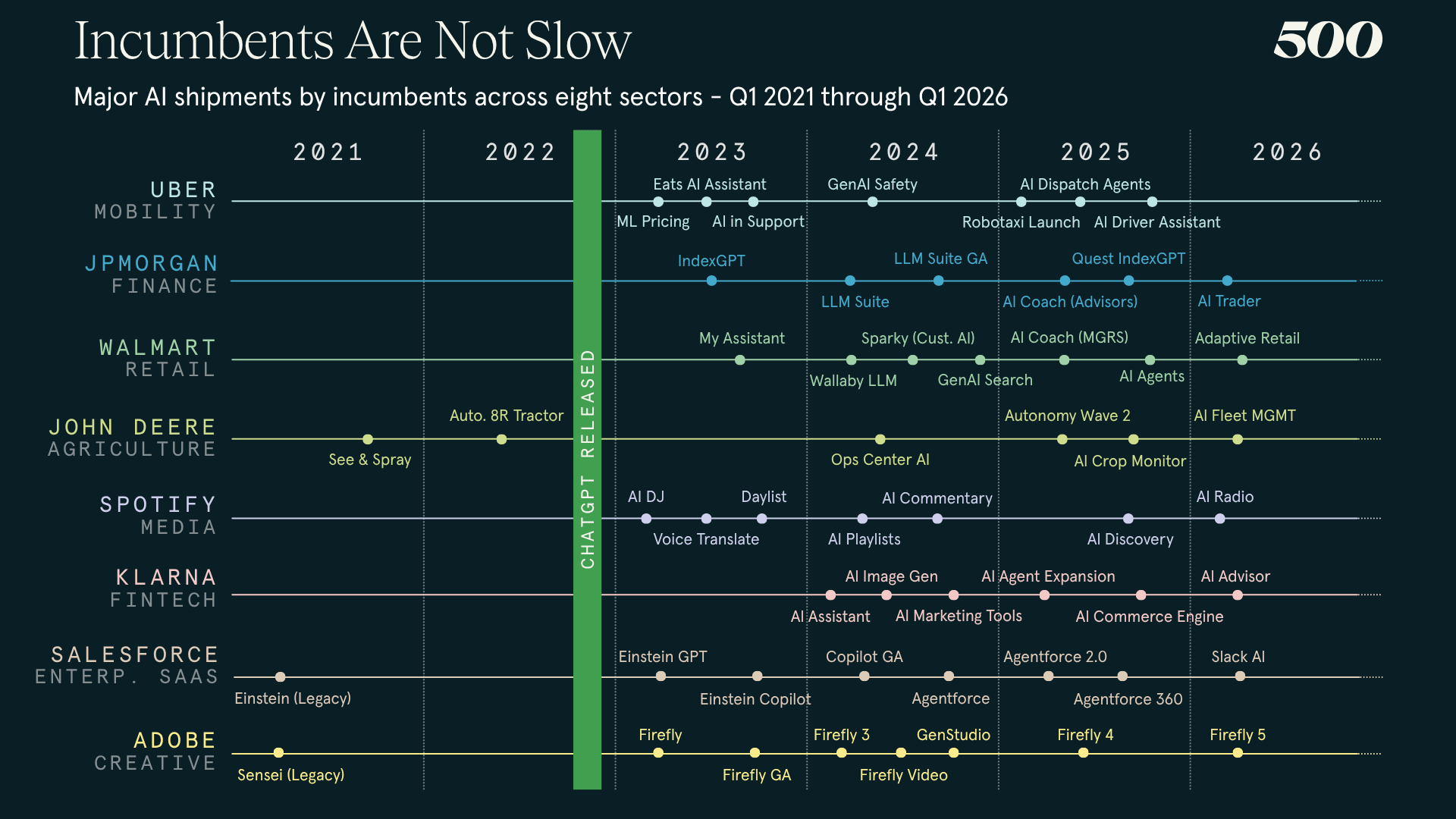
A sneak peak into the conversations that will be happening in San Francisco at VC Unlocked: AI Edition 2026 (June 1-4).
VC Unlocked: AI Edition is a four-day immersive venture capital program designed to equip experienced fund managers, VCs, and angel investors with the tools, insight, and conviction needed to lead in the next wave of AI investing.
![[Email] VCU AI Edition_KV.jpg](https://strapi-global-sites.s3.us-east-1.amazonaws.com/Email_VCU_AI_Edition_KV_5f3fc3af51.jpg)