2026.07.16

Uwem Uwemakpan
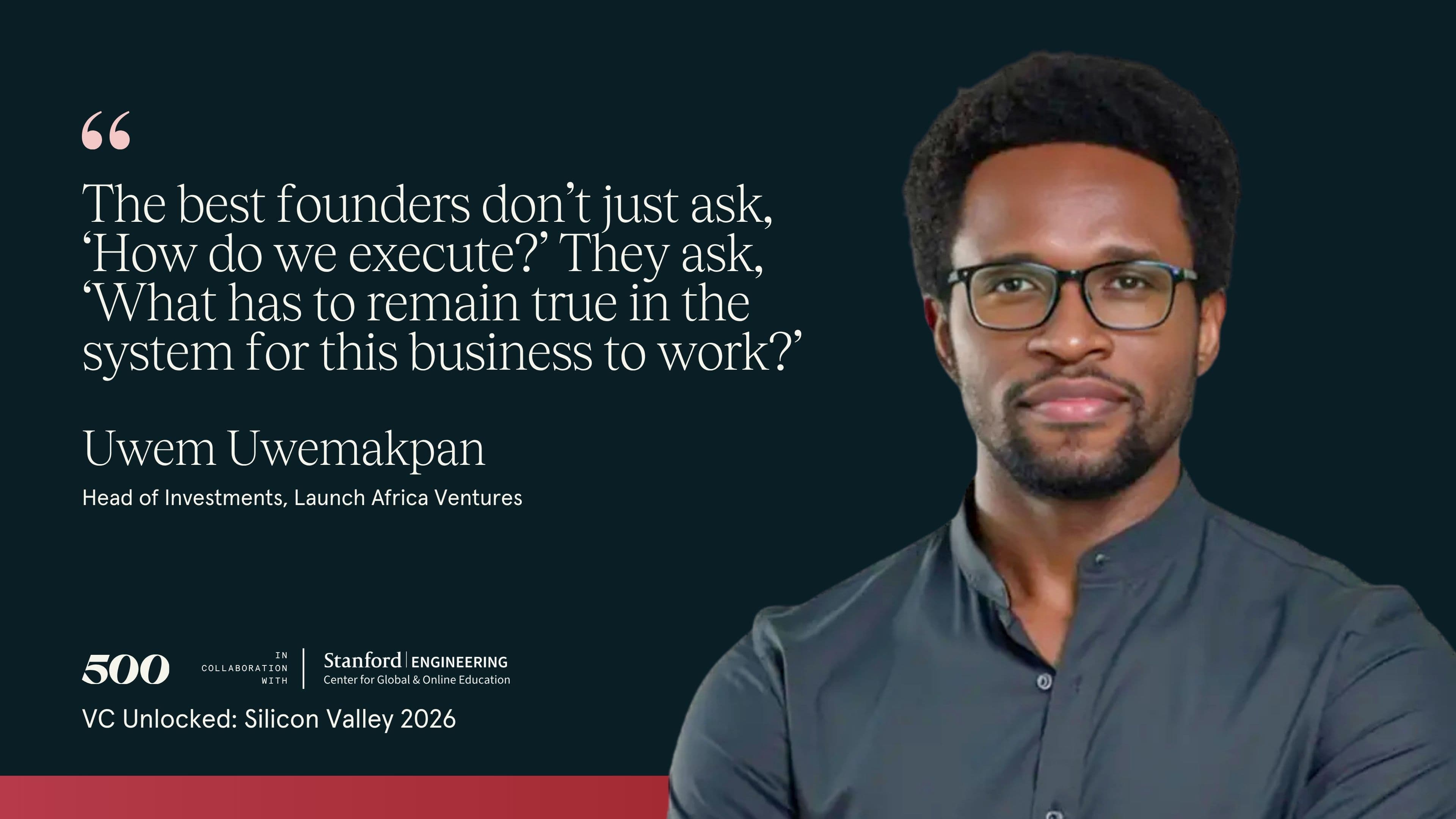
Uwem Uwemakpan is Head of Investments at Launch Africa Ventures, one of Africa's most active early-stage VC firms. Earlier this year, he was selected as one of four global scholarship recipients for VC Unlocked: Silicon Valley 2026, an invite-only programme by 500 Global, delivered in partnership with Stanford University. Ahead of the programme, Demola Adegbite, Partner, Africa at 500 Global, sat down with him for a conversation on investing across African markets, exploring where their perspectives converge, and why understanding systems, not just startups, increasingly defines successful venture investing.
DA: You've been investing across African markets for years. At this stage in your career, what drew you to VC Unlocked?
UU: At this point, it's not about learning the ecosystem in theory. It's about being in rooms where the right networks converge. LPs investing in emerging markets. Operators who've built global distribution from scratch. Fund managers whose conviction has been tested across cycles. I want to pressure-test my thinking against how they actually see and underwrite the world.
Because we're in a moment where some of the most important companies on the continent are being built, but global capital still hasn't fully caught up.
DA: One idea that increasingly resonates with me is that investing in Africa isn't simply about assessing the quality of a startup. It's about understanding whether the broader environment will allow that business to compound over time. In many ways, we're underwriting the systems around the company as much as the company itself. What are your thoughts on this?
UU: I agree. We tend to see the same patterns play out across African markets, and we aren't always honest about what they mean, or, at times, we simply ignore them.
I attended an Oxford Distinguished Speaker Seminar where André de Ruyter, former CEO of Eskom, described what happened as institutional drift. It wasn't a single failure. It was a system that lost internal coherence over time. It was a system that slowly stopped working, often without people noticing. The lights didn't go out overnight, they faded as small decisions, shifting incentives, and weakened accountability accumulated over time.
That pattern shows up in the venture capital ecosystem too. African startups don’t fail in isolation, they fail inside systems that are themselves drifting.
We back payments companies without mapping what happens when the grid fails, the gateway bank freezes settlement, or a new regulator owes nothing to the previous administration. We back logistics companies without asking which port chokepoint threatens the entire model. We back healthtech without interrogating the public infrastructure it quietly depends on.
The continent isn't short of great products. It's short of capital that understands the systems those products live inside.
DA: What does that tell you about how investors should think about risk in African markets?
UU: That Africa isn't uniquely risky, but it's frequently under-analysed.
The challenge isn’t opportunity. It’s legibility. Investors consistently underestimate how much of a startup’s outcome is pre-determined by infrastructure, institutions, and incentives already in motion. The edge comes from seeing those constraints before they show up in the numbers.
The investors who learn to map those dependencies properly will make better decisions, and over time, they'll attract more capital because they'll understand risk more accurately.
DA: That's an interesting point because people often say investing is about pattern recognition built through experience. But it sounds as though you're saying experience alone isn't enough.
UU: That's right.
Pattern recognition comes from deploying capital and seeing what actually breaks. But even that is incomplete on its own.
Proximity matters too: being around other investors who’ve lived through multiple cycles, geographies, and failure modes, and seeing how they made decisions when nothing was clear. That’s exactly why I wanted to attend VC Unlocked
DA: If investors need to understand systems better, I imagine founders do too. What distinguishes the ones who genuinely appreciate that complexity?
UU: The ability to distinguish effort from control.
A lot of founders over-index on execution and underweigh the forces already shaping their market, forces they don’t control, only operate within.
The best founders don’t just ask, “How do we execute?” They ask, “What has to remain true in the system for this to work?”
DA: When you step back from all of this, what are you ultimately trying to build as an investor?
UU: The ability to see what’s already true in a market before it shows up in performance data.
Every market has hidden dependencies. African markets simply make them visible faster, through infrastructure, regulation, currency, and political cycles.
The edge isn’t intuition. It’s being accurate about constraints.
The ability to map systems properly, not just intuit them.
DA: And perhaps that's ultimately what programmes like VC Unlocked are designed to accelerate, not simply access to knowledge, but the development of better mental models. Markets change. Technologies evolve. But the ability to understand how systems interact, and to price risk within them, is what allows investors to recognise opportunity before everyone else does.